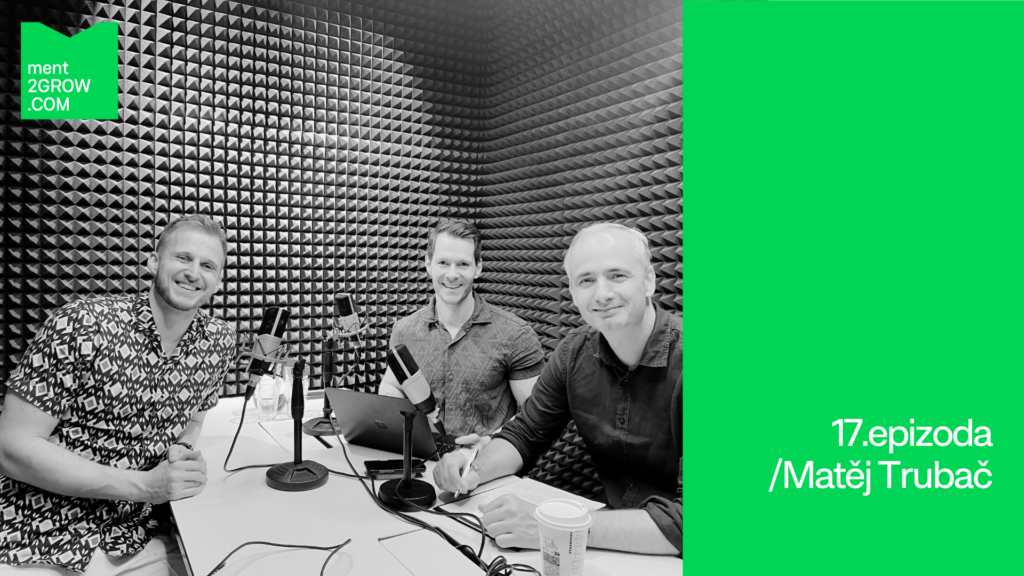
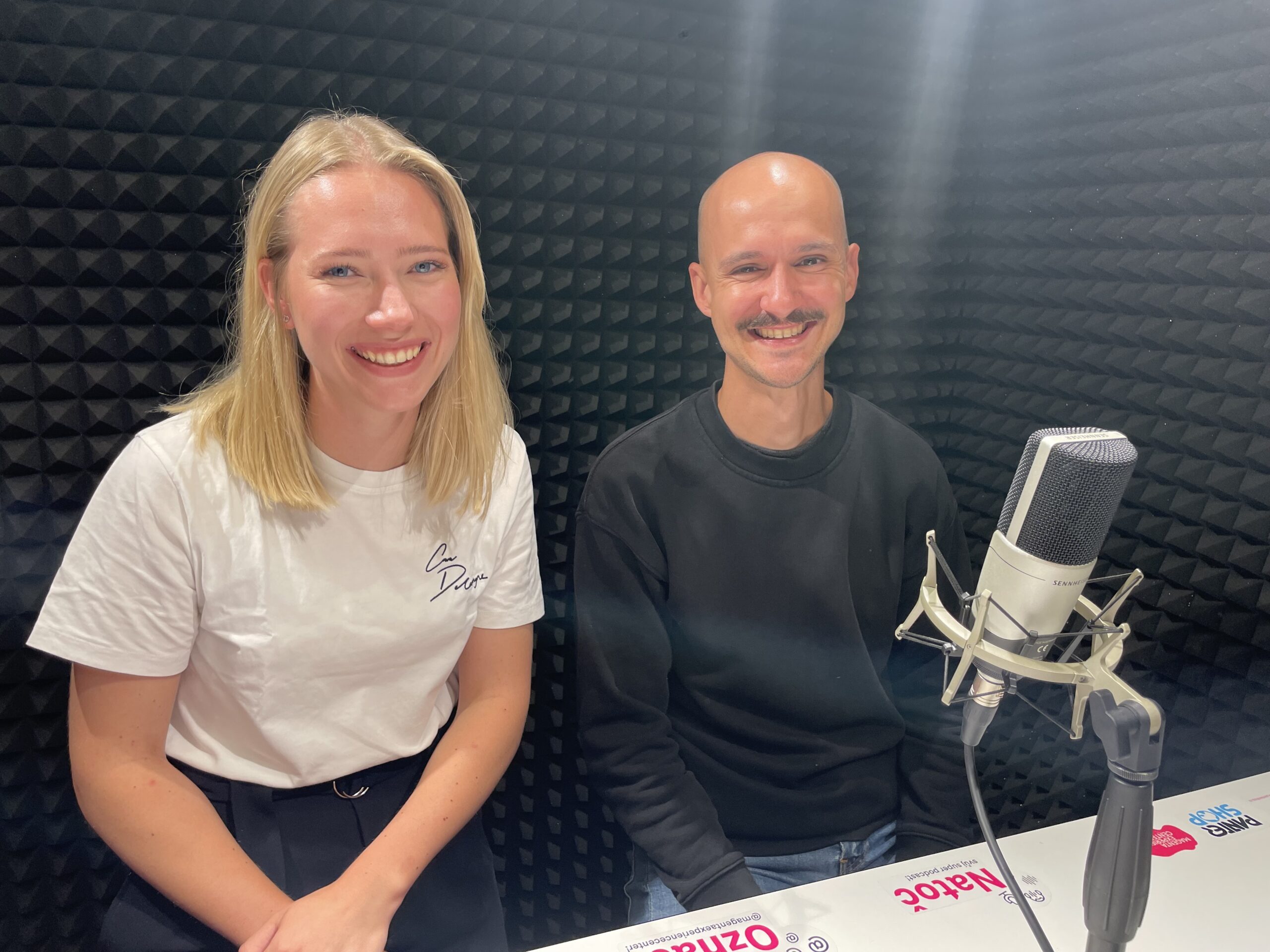
What challenges do Czech startups face, and how can accelerators, incubators, and other programs help them overcome these challenges? How do you choose the right accelerator? What can a startup expect from an accelerator, and how will it help the startup move forward? We’ll discuss this and more in Growcast she spoke Riva Karo, head of the accelerator program Ment2Grow, which is accepting applications for its sixth grade through the end of September—you can apply here, and Jirka Nováček from a startup Client.io, who shared his experiences with the program.
What are the current challenges facing Czech startups?
Riva: I'd look at it from two perspectives—or rather, two channels. I can't help but mention our friends from Czech Founders, who conduct surveys among Czech and Slovak startups from time to time to find out what’s troubling them and where they need help. The survey revealed that the main issues startups are currently dealing with—and that are of pressing concern to them—are sales and business development, product development, and management. These issues, of course, are further linked to other obstacles that keep piling up—such as insufficient government support. The Czech Founders community is actively addressing this issue by working to change legislation so that startups have better conditions in which to grow. Another pressing problem is related to fundraising, because what startups often lack for faster growth is sufficient seed capital.
This is also confirmed from a practical standpoint. The startups we encounter at Ment2Grow most often come to us saying they need to set up their sales processes.
Jirka, you've been a startup founder for quite some time now, and not just in Client.io. What do you think are the biggest challenges facing Czech startups?
I would agree with Riva and the survey mentioned. I think sales and marketing are usually the weakest areas for most startups in the Czech Republic. We’re good at making great products that work really well, but we don’t know how to sell them and capture the market. In contrast, what strikes me about the startup scene in the U.S. is that even though companies don’t necessarily have all the features they tout on their websites, they know how to sell them and achieve strong results even without a fully functional product.
How can accelerators or incubators help with this?
A: There are plenty of ways to go about it. Here, we can discuss the factors a startup should consider when deciding which accelerator or incubator to apply to. There are several factors to consider. The primary criterion to consider is whether you want to apply to an accelerator or incubator here in the Czech Republic or abroad. Another factor is whether the program takes equity in exchange for participation or if there’s a fee involved. And perhaps the most crucial factor is deciding based on your goals and expectations—specifically, what kind of help you need.
Jirka, what was your journey to Ment2Grow like? What led you to apply to the program, and what stage is the company at today?
First, I'd like to introduce Client.io. We’re a software company; we build products for developers, who then use them in the end-user applications they create for their customers. We have two products. JoinJS is a product that’s, let’s say, mature—we have over a thousand clients, including several Fortune 500 companies. It’s very niche—we became leaders in that space by chance. (laughter). Founder David was there at the very beginning of this industry, when workflow automation systems for desktop applications were moving to browsers and there was a need to create a diagramming library for the web. And that’s JoinJS. It was one of the first players in the market—a high-quality Czech product—so it gained a foothold and grew organically, and as a result, we’re now one of the global leaders.
The second product is Appmixer, which I am now primarily in charge of. When I joined Client.io When I joined, I was the first salesperson. Before that, CEO David handled it. Alexis is in charge of sales at JoinJS. (Manach, Ed.), who, for example, co-founded Non-Real Estate Companies. My goal is to make Appmixer, a white-label integration platform, a global leader. Ensuring exponential growth for Appmixer isn’t as easy as it seems, since the market is very competitive right now. That’s why I joined Ment2Grow. I’ve always enjoyed working with mentors—people with more experience—as well as with startups that don’t necessarily expect sales experts, but rather people who are product-oriented. Another reason I joined Ment2Grow is that you have a very impressive board with well-known figures, such as. Vítek Horký. I was looking forward to seeing who would give me advice.
Specifically, I was looking for someone who—ideally—had been there from the very beginning of a software company that had grown significantly and, during their time there, had hired 100 or 1,000 people who had gone through the same journey we’re on now.
Riva mentioned that there are questions I should ask myself at the outset before choosing an accelerator or incubator. And you mentioned that it also depends on who’s behind a given accelerator. What are some other factors I should consider to determine whether an accelerator is a good fit?
R: In my opinion, it’s important to ask yourself what stage of the startup journey you’re at and to make your choice based on that. There are plenty of programs out there—they’ve really taken off in the Czech Republic lately—but often they aren’t tailored to the development phase. So, in a program like that, you’ll have people who woke up yesterday deciding they wanted to start a startup alongside someone who’s had a startup for four years and is, naturally, in a completely different place. At Ment2Grow, we’ve found that people who are at a similar stage can share much more with one another and build a strong community. And often, they don’t even need an expert for that.
And then, as I said, what’s important is the problem I want to solve and the expectations I have. There are programs that focus more on mentoring—I’ll apply to those because I want an advisor who will guide me on my journey for a while. Or there are programs focused on networking and building connections. That’s one of the main cornerstones of our accelerator—connecting startups with potential clients, partners, and investors they wouldn’t otherwise be able to reach, whether in the Czech Republic or abroad.
But mentoring is important at Ment2Grow, too. Jirka, what has been your experience? What has mentoring given you during your time in the program?
I’d definitely like to sing its praises and recommend it to anyone who’s considering something similar. We were assigned great mentors. As for my past experience with mentoring, I’ve always—even during my time at Lumitrix, where I was taught by the wonderful Libor Mertl, for example—tried to surround myself with people who’ve already traveled the path I want to take. At Ment2Grow, I gained Natalia Zaharova, which has gone through Productboard a Apify, and Michal Mravinač.
Ment2Grow is an extremely practical accelerator for B2B startups. Why did you choose this particular format? Why didn’t you go the academic route instead?
R: To a certain extent, it’s clear. It’s like in school. If we just give each other theoretical advice on how to do things, it doesn’t add much value. It makes sense to us, instead of seeking out theoretical experts, to build a community of startup founders who pass on their know-how and share their journey with those who are 2–3 years behind them. And then to bring in experts who actually put their knowledge into practice in startups, such as SALESDOCk, HustáKomunikejšn, Mavericks Legal etc. This has proven to be a great way to learn these things.
Even the educational component of our program is a little different. Our workshops are more like discussion sessions, where experienced founders or experts share their experiences, and participants have the opportunity to talk with them about specific topics that concern them.
What are some other components that programs typically consist of?
A: We can’t leave out networking, which, in my opinion, is one of the most important pillars. It takes place on many levels, whether among the participating startups—which have the opportunity to maintain long-term contact with us, since other accelerators tend to be short-term and very intensive. Over the course of eight months, they build stronger relationships. There’s also networking at events, where they have the opportunity to meet potential partners, clients, or investors. This is where the great strength of independent accelerator programs lies—they have a much broader network within which to network. We also utilize a list of contacts to whom we can facilitate introductions, and, last but not least, we organize international business trips to attend various startup conferences and trade shows.
Jirka, now that the program is over, what do you need next? Where do you want to go from here?
I continue to work with my mentors. Natálie and I met every week during those eight months, and we’ve become good friends. We’re still in touch, and whenever I’m dealing with a specific issue, I can turn to her anytime. I meet with Michal once a month. It’s great to get the perspective of someone who runs a large company…
Networking was also an important part of the experience for me. Thanks to Ment2Grow and Opera I had the chance to take part in exciting events every month, whether in person or online.
You had the opportunity and the desire to get involved in the program. But that’s not the case for everyone—not everyone can find that much time for it. That brings me to a question, Riva: Who in the company is this program best suited for?
Ment2Grow is primarily designed for founders. Mentoring and other core activities are tailored specifically for them. At the same time, there are related activities (such as various mastermind groups) that we also organize for other team leaders, CMOs, and other team members.
I'd like to come back to that—so how should founders go about choosing? Would you recommend any other programs?
There are various programs here; for example, Google and CzechCrunch run programs for startups, and Czech Founders organizes great bootcamps. However, these are rarely tailored to a specific stage of a startup’s development; they’re based on pillars that are the same for everyone yet very different depending on the stage the company is in. It’s important to carefully assess whether you fit the description of an ideal participant. That reminds me—Jirka called me even before the next Ment2Grow session began to ask about a few things. And that’s a great approach for both sides, because it shows he’s genuinely interested in committing to it.
J: I’d also add StartupYard. Or my alma mater, the University of Economics in Prague (VŠE), has its own accelerator program called xPORT, so you can apply to a program like that even while you’re still a student. Personally, I wasn’t even looking for accelerators, but I needed a mentor, and I found a great one at Ment2Grow.
Ment2Grow has had many successful editions that have produced a host of startups with experience, so it’s a good idea to ask for personal recommendations as well. The startup community is very close-knit…
Who exactly is Ment2Grow intended for?
A: It’s for B2B startups that are at a specific stage of development, have an existing product and paying customers, and want help primarily with business development, whether in the Czech Republic or abroad. In connection with this, we partnered with Czech Founders this year to create a project supporting international expansion—CoEx, a directory where you can find contacts for various international markets, available to Ment2Grow participants as well as the Czech Founders Forum community. We can facilitate introductions to them.
What can founders look forward to at Ment2Grow?
A fantastic network of people who have a wealth of experience and can share a vast amount of expertise that would otherwise be hard to come by. Starting in September, we’ll be accepting applications for the sixth year of the program, and you can apply online at www.ment2grow.com And I'm already looking forward to the next batch!
Author: Tereza Bartošková